
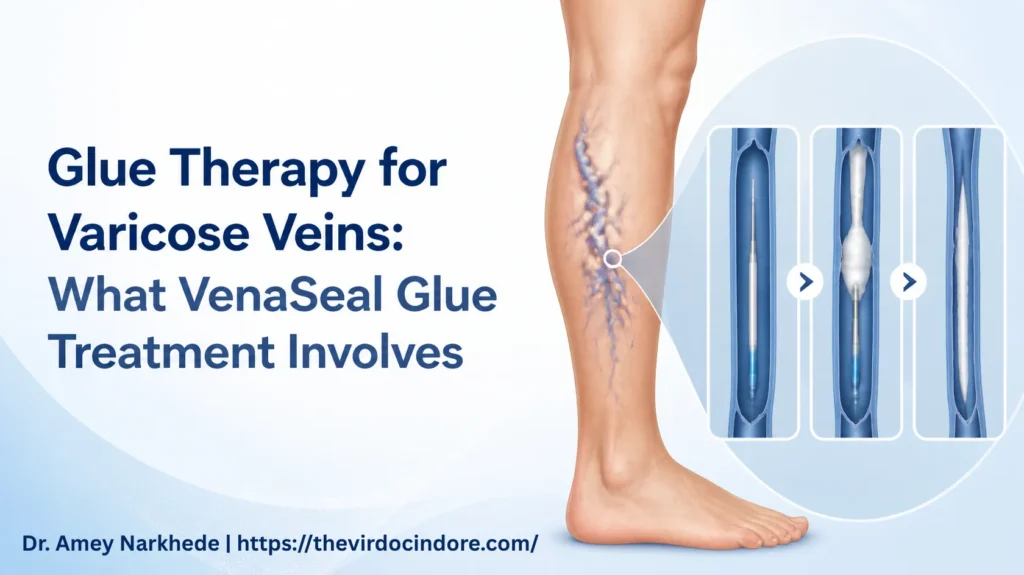
Glue therapy for varicose veins is a non-surgical, minimally invasive way to close a faulty leg vein using a medical-grade adhesive. The best-known system is VenaSeal, which uses a cyanoacrylate glue instead of heat or numbing fluid. It is an attractive idea: a small puncture, no thermal injury, and often no compression stockings. But the glue also has its own risks, and it is not the first-line choice in every guideline. This guide explains how VenaSeal glue treatment works, what the evidence shows, who may be suited to it, and the questions to ask before you decide.
What Is Glue Therapy for Varicose Veins?
Varicose veins are swollen, twisted veins, most often in the legs. They usually develop when valves inside a main (truncal) vein, commonly the great saphenous vein, stop working, so blood flows backwards and pools. This is called venous reflux.
Glue therapy, also called cyanoacrylate closure, treats that faulty vein from the inside. A thin catheter is placed in the vein under ultrasound guidance, and small amounts of medical-grade glue are delivered along its length. The vein walls are held together until the vein seals shut. The vein is not removed. Blood is carried by healthy veins instead, and the treated vein is gradually absorbed into the surrounding tissue.
VenaSeal is described by its manufacturer as a nonthermal, nontumescent and nonsclerosant system, which means it does not use heat, does not need large volumes of numbing fluid around the vein, and does not rely on a vein-hardening drug.
How VenaSeal Glue Treatment for Varicose Veins Works
The steps are similar to other catheter-based vein treatments:
- Duplex ultrasound. A scan maps which veins have reflux and how large they are. This decides whether glue is suitable at all.
- Access. After a small area of skin is numbed, a thin catheter is introduced into the vein through a tiny puncture.
- Glue delivery. Under ultrasound guidance, the glue is delivered in small segments along the vein while the catheter is withdrawn. The doctor presses on the leg with the ultrasound probe to help the walls stick together.
- Check scan. The doctor confirms the vein has closed, and a small dressing is applied.
- Follow-up. A review, usually with a repeat duplex scan, checks that the vein has stayed closed and that the leg is settling well.
Because there is no heat, the procedure does not need multiple injections of tumescent anaesthetic. Compression stockings after treatment may not be required, although your doctor may still recommend them.
Benefits of Medical-Grade Glue for Varicose Veins
- A single small puncture instead of an incision
- No thermal energy, so no heat-related skin or nerve injury from the device
- Usually only local anaesthetic at the puncture site
- Walking soon afterwards and a quick return to routine
- Compression stockings may not be needed, which some patients find easier in warm weather or when stockings are hard to put on
These advantages are not guaranteed, and they need to be weighed against the risks described below.
What Does the Evidence Say About VenaSeal?
The main trial is VeClose, a randomised study that compared VenaSeal with radiofrequency ablation (RFA) for the great saphenous vein. Its five-year extension followed a smaller group of the original patients: 89 patients completed the 60-month visit, including 47 treated with VenaSeal and 33 with RFA. In the announced results, 94.6% of the VenaSeal-treated veins that were followed were closed at five years, and a Kaplan-Meier estimate found glue to be non-inferior to RFA (91.4% for VenaSeal versus 85.2% for RFA).
Three points matter when reading these numbers:
- The five-year results were announced by the device manufacturer, and fewer patients were followed at five years than were treated at the start.
- The findings apply mainly to the great saphenous vein. Some vein specialists are more cautious about using glue in the small saphenous vein.
- Closure rate is only one measure. Symptoms, skin changes, quality of life and side effects matter just as much.
Risks and Side Effects of Cyanoacrylate Glue Closure
Glue closure is generally well tolerated, but it carries a risk that thermal treatments do not: the glue stays in the body permanently as a foreign material. Some people react to it.
- Phlebitis-like reaction. Redness, tenderness, itching, swelling and a hard, sore cord along the treated vein. This is thought to be a delayed (type IV) hypersensitivity reaction, and it often appears about two to three days after treatment. Most reactions settle, but some need anti-inflammatory medicine, antihistamines or steroids.
- How common is it? Published reports vary. Hypersensitivity events have been reported in roughly 6% to 11% of cases in some literature, and one review quoted local reactions in up to a quarter of patients. A large national survey from Japan found localised phlebitis needing additional treatment in about 6.8% of patients.
- Rare serious events. The same survey recorded a small number of serious infections needing the glue to be removed, nine glue removals in total, and one death from a pulmonary embolism. Deep vein thrombosis is also a recognised, uncommon risk of any vein closure procedure.
- Other risks. Bruising, a lump or granuloma at the treated site, and incomplete closure or recurrence of the varicose vein.
People with a known allergy to acrylates or cyanoacrylates (found in some adhesives and nail products) should tell their doctor, because such patients are generally advised not to receive this treatment. Reactions have been linked in some reports to veins lying very close to the skin and to larger veins, and some researchers have discussed patch testing, although its value is debated.
Contact your doctor promptly if you develop spreading redness, increasing pain, fever, calf pain or swelling of the leg, or sudden breathlessness or chest pain.
Glue vs Laser (EVLT), RFA and Foam Sclerotherapy
| Option | How it works | Anaesthesia | Compression stockings | Points to consider |
| Glue closure (VenaSeal) | Adhesive seals the vein from inside | Local at puncture site | May not be needed | Non-thermal; glue remains in the body; risk of phlebitis-like or allergic reaction |
| Endovenous laser ablation (EVLT) | Laser heat closes the vein | Local, with numbing fluid around the vein | Usually advised | Long track record; first-line in UK guidance for truncal reflux |
| Radiofrequency ablation (RFA) | Radiofrequency heat closes the vein | Local, with numbing fluid around the vein | Usually advised | First-line in UK guidance; the comparator in the VeClose trial |
| Foam sclerotherapy | A foam medicine is injected to close the vein | Usually none or local | Often advised | Considered when heat ablation is unsuitable; repeat sessions may be needed |
The UK NICE guideline on varicose veins recommends heat-based ablation (RFA or laser) as the first treatment for a main vein with confirmed reflux. NICE has issued separate guidance on cyanoacrylate glue occlusion, but a systematic review notes that it did not promote glue for routine use. In practice, glue is one reasonable option for selected patients, not a replacement for every other treatment.
Who May Be Suitable for Glue Therapy for Varicose Veins?
Glue closure may be considered if you:
- Have symptomatic varicose veins with reflux confirmed on duplex ultrasound
- Have a suitable great saphenous vein that can be treated with a catheter
- Prefer to avoid heat-based treatment or long stocking use, and understand the risks
- Have difficulty wearing compression stockings
Another option may be safer or more suitable if you:
- Have a known acrylate or cyanoacrylate allergy
- Have a history of significant allergic or inflammatory reactions to adhesives or implants
- Have an active infection, an acute deep vein clot or a very superficial or very large vein
- Are pregnant, because interventional treatment is usually deferred
The right choice is made after examination and a duplex scan, not before.
Recovery After Glue Treatment for Varicose Veins
Most patients walk straight away and go home soon after. Mild tenderness, tightness or bruising along the treated vein is common in the first days. Many people return to routine activity quickly, but heavy lifting and strenuous exercise are usually limited briefly. Report any redness, itching, swelling or pain that develops in the days after treatment, because early treatment of a reaction helps. A follow-up scan confirms that the vein has closed. Walking, weight control and avoiding long periods of standing help protect your other veins, and new varicose veins can still develop over time.
Glue Therapy for Varicose Veins: Cost and What Affects It
There is no single price for glue therapy for varicose veins. The cost depends on:
- Whether one or both legs need treatment, and how many veins
- The device and adhesive kit used
- The hospital or day-care facility, room type and length of stay
- Duplex scans, tests and follow-up visits
- Any stockings, medicines or review visits
- Your insurance policy, since cover varies and often depends on medical necessity
Ask for a written estimate that states what is included. A personalised figure after your scan is more reliable than prices quoted online.
How to Choose the Right Vein Specialist for Glue or Any Vein Treatment
- Duplex-based assessment. Treatment should be planned from a vein scan, not from appearance alone.
- Honest comparison of options. A good specialist explains laser, radiofrequency, foam, glue and conservative care, and says when each is better.
- Allergy screening. Ask whether your allergy history has been checked before any glue is used.
- Clear consent. Risks, recurrence and the fact that glue stays in the body should be discussed openly.
- Written follow-up plan and estimate.
Be cautious of anyone who describes glue treatment as completely risk-free or promises permanent results.
Consult Dr. Amey Narkhede About Varicose Vein Treatment in Indore
Dr. Amey Narkhede is a vascular interventional radiologist (M.B.B.S., D.N.B., F.V.I.R.) with 12+ years of experience, who consults at VIR Clinic, 19 Ravindra Nagar, Indore. A consultation starts with your history and a vein ultrasound, followed by an honest comparison of the options that suit your veins. You can read about the full range of choices on our varicose vein treatment in Indore page, or learn more on the doctor’s profile page.
Call (+91) 9993020335 or email thevirdocindore@gmail.com to book a consultation. Bring any previous scan reports.
Frequently Asked Questions About Glue Therapy for Varicose Veins
What is glue therapy for varicose veins?
Glue therapy is a minimally invasive treatment in which a medical-grade cyanoacrylate adhesive is delivered through a thin catheter to close a faulty vein from the inside. The vein is not removed, and blood flows through healthy veins instead.
What is VenaSeal glue treatment?
VenaSeal is a branded closure system that uses a cyanoacrylate adhesive to seal diseased superficial veins, most commonly the great saphenous vein. It does not use heat, tumescent anaesthesia or a vein-hardening drug.
Is medical-grade glue for varicose veins safe?
It is generally well tolerated, and trials have reported high closure rates. However, the glue stays in the body, and some people develop a phlebitis-like or allergic reaction, usually within days. Rare serious complications have been reported. Your doctor should discuss these risks and screen for acrylate allergy before treatment.
Is VenaSeal glue treatment painful?
Most people feel little pain during the procedure, because only the puncture site is numbed and there is no heat. Mild tenderness or tightness along the vein can follow.
Do I need compression stockings after glue treatment?
They may not be required, but your doctor may still recommend them. Follow the advice you are given for your own leg.
Can varicose veins come back after glue treatment?
Yes. Any varicose vein treatment can fail to close a vein completely, and new varicose veins can form over time. A follow-up scan helps detect problems early.
Is glue better than laser or radiofrequency treatment?
Not for everyone. Laser and RFA are first-line options in UK guidance and have a long track record. Glue avoids heat and may suit some patients, but it has its own reaction risk. The choice depends on your vein anatomy, allergy history, preferences and your doctor’s assessment.
What is the cost of glue therapy for varicose veins in Indore?
The cost depends on the number of veins and legs treated, the device used, the facility, scans and follow-up, and your insurance. A reliable figure can be given only after examination, so call (+91) 9993020335 and ask for a written estimate stating what is included.
Medical disclaimer: This page is for general information and does not replace medical advice, diagnosis or treatment. Results vary between patients, and no outcome can be guaranteed. Always consult a qualified doctor about your own condition.
References
- Morrison N, Gibson K, McEnroe S, et al. Randomized trial comparing cyanoacrylate embolization and radiofrequency ablation for incompetent great saphenous veins (VeClose). J Vasc Surg. 2015;61(4):985-994. doi: 10.1016/j.jvs.2014.11.071.
- Five-Year Outcomes Support Medtronic’s VenaSeal Closure System in Patients With Chronic Venous Disease. Endovascular Today, 17 April 2019. https://evtoday.com/news/five-year-outcomes-support-medtronics-venaseal-closure-system-in-patients-with-chronic-venous-disease
- VeClose extension study five-year results (Morrison). Phlebolymphology. https://www.phlebolymphology.org/?p=8660
- Umetsu M, et al. Safety assessment of cyanoacrylate closure for treatment of varicose veins in a large-scale national survey in Japan. J Vasc Surg Venous Lymphat Disord, 2024. https://www.ncbi.nlm.nih.gov/pmc/articles/PMC12014294/
- Umetsu M, et al. Serious Adverse Events with Cyanoacrylate Closure of Varicose Veins: An Initial Report from a Large-Scale National Survey in Japan. Annals of Vascular Diseases, 2024;17(1):21-24. https://www.ncbi.nlm.nih.gov/pmc/articles/PMC11018107/
- Review urges development of protocols to reduce hypersensitivity reactions after cyanoacrylate varicose vein treatment. Vascular Specialist. https://vascularspecialistonline.com/?p=15587
- NICE. Cyanoacrylate glue occlusion for varicose veins (HealthTech guidance 540). https://www.nice.org.uk/guidance/htg540
- Systematic review of n-butyl-2-cyanoacrylate (NBCA) glue for truncal varicose veins versus other endovascular techniques. https://pmc.ncbi.nlm.nih.gov/articles/PMC7305022