
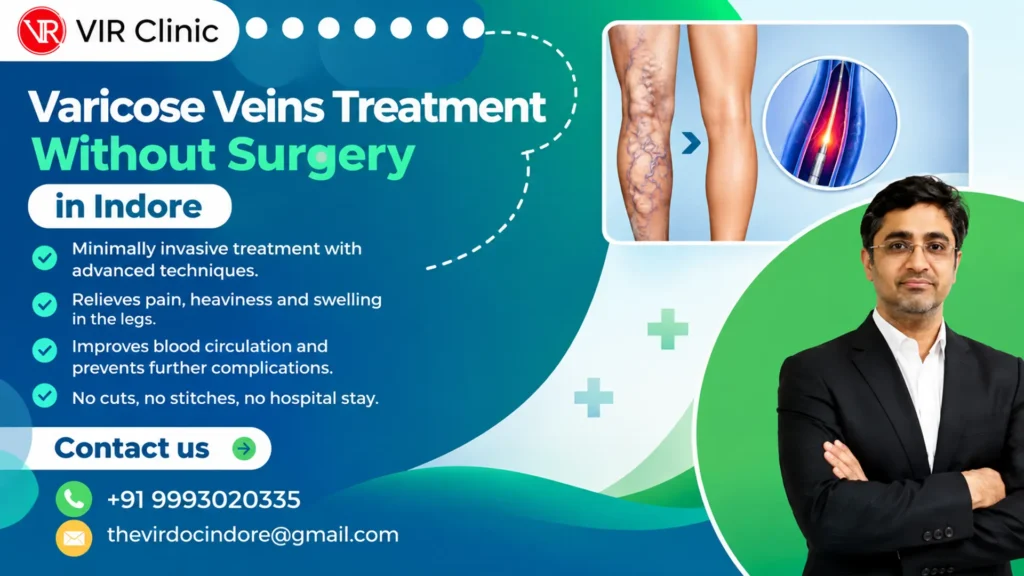
Varicose veins are enlarged, twisted veins that commonly appear on the legs when blood does not flow efficiently back toward the heart. They may cause visible bulging veins, heaviness, aching, swelling, itching, cramps, or skin changes. Although mild cases can sometimes be managed with lifestyle measures, persistent or symptomatic varicose veins may require medical treatment.
Varicose Veins Treatment Without Surgery in Indore has become an important option for people looking for minimally invasive approaches that do not involve traditional vein-stripping surgery. Depending on the vein anatomy, symptoms, and ultrasound findings, treatments such as endovenous thermal ablation, sclerotherapy, or other image-guided procedures may be considered.
For patients searching for Varicose Veins Treatment Without Surgery in Indore, an appropriate treatment plan should begin with a detailed evaluation rather than choosing a procedure based only on visible veins.
Symptoms and Causes of Varicose Veins
Common Symptoms
Varicose veins can range from a cosmetic concern to a condition causing significant leg discomfort. Common symptoms include:
- Bulging or twisted blue, purple, or greenish veins
- Aching or throbbing in the legs
- Leg heaviness or fatigue
- Swelling around the ankles or lower legs
- Itching or burning sensation
- Muscle cramps, particularly at night
- Skin discoloration
- Tenderness around affected veins
- Restlessness or discomfort after prolonged standing
In more advanced cases, chronic venous insufficiency can contribute to skin changes, inflammation, ulcers, or superficial thrombophlebitis.
Why Do Varicose Veins Develop?
Healthy leg veins contain one-way valves that help blood travel upward toward the heart. When these valves become weak or incompetent, blood can flow backward and pool within the veins. Over time, the affected veins may enlarge and become visible beneath the skin.
Factors associated with varicose veins include:
- Family history of venous disease
- Increasing age
- Pregnancy
- Prolonged standing or sitting
- Previous blood clots
- Being overweight
- Reduced physical activity
- Changes in the vein walls or valves
Not everyone with visible varicose veins requires an intervention. Treatment depends on symptoms, clinical findings, venous reflux, and the patient’s overall condition.
Diagnosis and Non-Surgical Treatment Options
How Are Varicose Veins Diagnosed?
A consultation usually begins with a medical history and physical examination. The doctor may assess the appearance of the veins, swelling, skin changes, pain, and other symptoms.
A venous duplex ultrasound is commonly used to evaluate blood flow, identify abnormal valve function, assess venous reflux, and check for other problems such as blood clots.
For patients considering Varicose Veins Treatment Without Surgery in Indore, ultrasound findings are particularly important because the visible vein is not always the source of the problem. The underlying refluxing vein needs to be identified before selecting treatment.
Endovenous Vein Ablation
Varicose Vein Treatment may involve endovenous thermal ablation when an incompetent superficial vein is responsible for symptoms and varicosities.
During the procedure, the doctor uses ultrasound guidance to place a thin catheter into the affected vein. Radiofrequency or laser energy is then delivered to the vein, causing it to close. Blood is subsequently redirected through healthier veins.
The procedure generally involves a very small skin opening rather than a large surgical incision. It is commonly performed as an outpatient procedure, although individual circumstances can vary.
Sclerotherapy and Other Minimally Invasive Options
Sclerotherapy involves injecting a medication into selected veins to make them shrink and eventually close. It is commonly used for smaller varicose veins and spider veins, depending on the clinical situation.
Phlebectomy is another minimally invasive option in selected patients. It removes superficial varicose veins through very small skin openings and may sometimes be combined with endovenous ablation.
Guidelines from NICE recommend endothermal ablation for people with confirmed varicose veins and truncal reflux when appropriate; if this is unsuitable, ultrasound-guided foam sclerotherapy may be considered, with surgery reserved for situations where these options are unsuitable.
Therefore, Varicose Veins Treatment Without Surgery in Indore does not mean that every patient receives the same procedure. Treatment should be individualized after clinical and ultrasound assessment.
Benefits, Recovery and Comparison With Surgery
Benefits of Minimally Invasive Treatment
For suitable patients, minimally invasive treatment can offer several advantages:
- No large surgical incision
- Small access point for catheter-based procedures
- Local anesthesia is commonly used for endovenous ablation
- Shorter recovery compared with traditional vein-stripping surgery
- Less postoperative discomfort in many patients
- Minimal scarring
- Ability to return to normal activities relatively quickly
RadiologyInfo notes that endovenous ablation is less invasive than conventional surgery and is associated with less pain during recovery in comparison with traditional vein stripping.
What Is Recovery Like?
Recovery depends on the procedure performed and the patient’s health. After endovenous ablation, patients are generally encouraged to remain active rather than spending prolonged periods in bed. Compression stockings may be recommended to reduce bruising and tenderness and according to the treating doctor’s instructions.
Patients should follow their doctor’s instructions regarding:
- Walking and physical activity
- Compression stockings
- Exercise
- Wound care
- Long-distance travel
- Follow-up appointments
A follow-up ultrasound may be performed after treatment to confirm closure of the treated vein and assess for complications.
Non-Surgical Treatment vs Traditional Surgery
| Feature | Minimally Invasive Treatment | Traditional Vein Surgery |
| Large incision | Usually not required | May be required |
| Common approach | Catheter/image-guided | Surgical |
| Anesthesia | Often local for ablation | Depends on procedure |
| Recovery | Generally shorter | Generally longer |
| Scarring | Usually minimal | Can be more noticeable |
| Suitability | Depends on vein anatomy | Used when other options are unsuitable |
The choice should not be based solely on recovery time. The anatomy of the veins, severity of reflux, symptoms, previous treatment, and overall health all influence the appropriate approach.
FAQs About Varicose Veins Treatment Without Surgery in Indore
1. Can varicose veins be treated without surgery?
Yes. Selected patients may be treated using minimally invasive techniques such as endovenous thermal ablation or sclerotherapy. The appropriate option depends on the underlying venous problem and ultrasound findings.
2. What is Varicose Vein Treatment?
Varicose Vein Treatment refers to medical approaches used to manage symptomatic or problematic varicose veins. Depending on the condition, treatment may include lifestyle measures, compression, ablation, sclerotherapy, or phlebectomy.
3. Is laser treatment used for varicose veins?
Yes. Endovenous laser treatment uses laser energy to close an incompetent vein. It is performed using ultrasound guidance and a thin catheter.
4. Is radiofrequency ablation different from laser treatment?
Both are forms of endovenous thermal ablation. Radiofrequency uses radiofrequency energy, while laser treatment uses laser energy to heat and close the targeted vein. Your doctor can determine which approach is appropriate based on your vein anatomy and clinical findings.
5. Does every patient with varicose veins need treatment?
No. Treatment is not automatically required for every visible varicose vein. Symptoms, complications, venous reflux, severity, and individual circumstances should be assessed before treatment is recommended.
6. How is the cause of varicose veins identified?
A clinical examination combined with venous duplex ultrasound can help identify abnormal blood flow and venous reflux and guide treatment planning.
7. Can varicose veins come back after treatment?
New varicose veins can develop over time, and some patients may have residual or recurrent veins. Follow-up and management depend on the underlying venous disease and the treatment performed.
8. Is recovery after ablation quick?
Many patients can return to normal daily activities relatively quickly after endovenous ablation, but recovery varies. Strenuous exercise and other activities may need temporary modification according to the doctor’s instructions.
9. Who should I consult for varicose veins in Indore?
An appropriately trained vascular specialist or interventional radiologist can evaluate your symptoms and venous ultrasound findings and determine whether minimally invasive treatment is appropriate.
Conclusion
Varicose Veins Treatment Without Surgery in Indore provides minimally invasive treatment possibilities for appropriately selected patients with symptomatic or problematic varicose veins. Endovenous ablation, sclerotherapy, and selected minimally invasive procedures can address abnormal veins without the large incisions associated with traditional vein-stripping surgery.
However, treatment should always be individualized. A proper clinical assessment and venous duplex ultrasound can help identify the source of venous reflux and determine whether Varicose Vein Treatment is necessary and which procedure may be suitable.
Book a Consultation With Dr. Amey Narkhede
If you are experiencing painful, swollen, bulging, or increasingly prominent veins, consult Dr. Amey Narkhede, an Interventional Radiologist in Indore, for an evaluation of your condition and treatment options.
Services may include minimally invasive vascular and interventional radiology procedures, including evaluation and treatment of varicose veins and other venous conditions.
If you are looking for Varicose Veins Treatment Without Surgery in Indore, schedule an appointment with Dr. Amey Narkhede to discuss your symptoms, venous ultrasound findings, and suitable treatment options.