
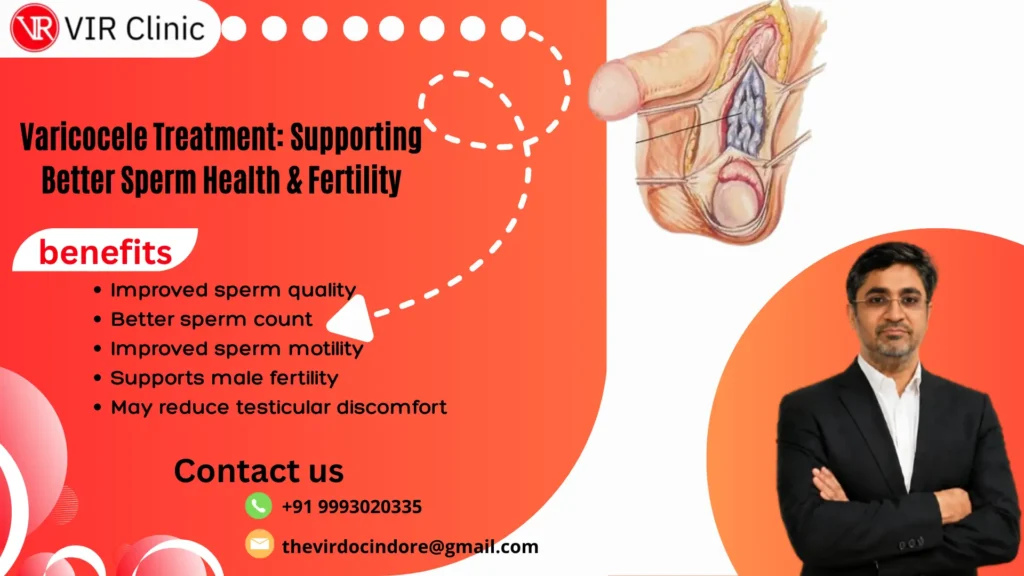
Varicocele is an enlargement of the veins within the scrotum and is a common condition in men. Although some varicoceles cause no noticeable symptoms, others may be associated with scrotal discomfort, testicular changes, or abnormal semen parameters. Because sperm production depends on an appropriate testicular environment, a clinically significant varicocele may affect male reproductive health in some men.
Varicocele Treatment for Male Fertility focuses on treating the abnormal venous blood flow while considering the patient’s symptoms, semen analysis, fertility goals, age, and overall reproductive health. Current AUA/ASRM guidance recommends considering repair particularly for men attempting conception who have a palpable varicocele, infertility, and abnormal semen parameters.
Modern interventional radiology also provides a minimally invasive option called varicocele embolization. Instead of making a surgical incision in the scrotum, an interventional radiologist uses image guidance and a catheter to block abnormal venous blood flow. CIRSE has published specific standards of practice for varicocele embolisation, reflecting its established role within interventional radiology.
For men searching for Varicocele Treatment for Male Fertility, understanding the condition, diagnosis, treatment choices, benefits, and expected recovery can help in making an informed decision.
What Is Varicocele and How Can It Affect Male Fertility?
A varicocele develops when veins responsible for draining blood from the testicles become enlarged and blood flows abnormally or pools within them. The condition is more frequently found on the left side because of differences in venous anatomy.
Not every varicocele requires treatment. Some men have no symptoms and maintain normal fertility. Treatment decisions are generally based on clinical findings and the individual’s reproductive goals rather than the presence of a varicocele alone.
Symptoms of Varicocele
Common symptoms and signs may include:
- Dull or aching scrotal pain
- A feeling of heaviness in the scrotum
- Discomfort that becomes more noticeable after prolonged standing or physical activity
- Enlarged or twisted scrotal veins
- Testicular size differences
- Difficulty conceiving
- Abnormal semen analysis
- Occasionally, reduced testicular growth in younger patients
Some men discover a varicocele only during an infertility evaluation.
Varicocele and Male Fertility
The connection between Varicocele and male fertility is important because the enlarged veins can alter the local testicular environment. Factors such as increased scrotal temperature, altered venous drainage, oxidative stress, and changes in testicular function have been proposed as mechanisms affecting sperm production.
However, having a varicocele does not automatically mean that a man is infertile. Fertility is influenced by multiple factors, including sperm production, sperm motility, sperm morphology, hormones, female-partner factors, and other reproductive conditions.
Therefore, Varicocele Treatment for Male Fertility should be personalized rather than based solely on an ultrasound finding.
Causes and Risk Factors
A varicocele is generally associated with malfunctioning venous valves and abnormal blood drainage. Anatomical differences in the testicular veins also explain why left-sided varicoceles are common.
Potential contributing factors include:
- Abnormal or weak venous valves
- Increased venous pressure
- Anatomical differences in venous drainage
- Family tendency toward venous problems
- Previous venous or abdominal conditions in selected cases
A sudden-onset, unusually large, or non-reducible varicocele may require additional medical assessment.
Diagnosis and Treatment Options for Varicocele
Proper diagnosis is essential before choosing Varicocele Treatment for Male Fertility. A specialist generally combines clinical examination with appropriate investigations.
Diagnosis
Evaluation may include:
Physical examination:
The doctor checks the scrotum while the patient is standing and may assess whether enlarged veins are palpable.
Scrotal Doppler ultrasound:
This imaging test evaluates the veins and blood flow and can help identify reflux associated with a varicocele.
Semen analysis:
For men concerned about fertility, semen analysis provides important information about sperm concentration, motility, and morphology.
Hormonal assessment:
Depending on the clinical situation, testosterone and other reproductive hormones may be evaluated.
Fertility history:
The duration of infertility, previous pregnancies, previous treatments, and other reproductive factors should be considered.
Importantly, AUA/ASRM guidance does not recommend surgical repair for non-palpable varicoceles detected only on imaging.
Varicocele Embolization
Varicocele embolization is a minimally invasive treatment performed by a vascular and interventional radiologist.
During the procedure, the doctor:
- Uses local anesthesia.
- Accesses a suitable vein through a small puncture.
- Guides a thin catheter toward the abnormal testicular vein using imaging.
- Identifies abnormal venous flow.
- Place embolic material, such as coils or another appropriate embolic agent, to block the abnormal vein.
- Removes the catheter after treatment.
- Allows blood to redirect through healthier veins.
Unlike conventional surgical repair, embolization does not require a surgical incision in the scrotum.
The choice between embolization and surgery should be individualized. The AUA/ASRM guideline recognizes surgical varicocelectomy as an option for appropriately selected men with palpable varicocele, infertility, and abnormal semen parameters, while percutaneous embolization is another established approach used in interventional radiology.
Benefits of Varicocele Treatment
Potential benefits of appropriately treating a clinically significant varicocele may include:
- Addressing abnormal venous blood flow
- Reduction in varicocele-related discomfort
- Improvement in semen parameters in some patients
- Supporting reproductive goals
- Avoiding or reducing the need for open surgical treatment in suitable embolization candidates
- Small access site rather than a larger surgical incision
- Generally shorter recovery after minimally invasive embolization
Evidence indicates that varicocele repair can improve semen parameters in appropriately selected men, although fertility outcomes vary between individuals.
It is important not to promise pregnancy or a specific improvement in sperm count after treatment. Varicocele and male fertility are related, but infertility can have several causes.
Recovery After Varicocele Embolization
Recovery after embolization is generally quicker than recovery from many surgical procedures, although the exact experience differs between patients.
Patients may experience mild soreness or bruising around the catheter access site. The treating specialist provides individualized instructions regarding exercise, heavy lifting, medications, and follow-up.
Follow-up may include repeat clinical assessment and semen analysis. AUA/ASRM guidance emphasizes that fertility treatment should be evaluated over time, and semen parameters may require follow-up rather than immediate assessment after treatment.
Varicocele Embolization vs Surgical Treatment: Which Is Better?
There is no single treatment that is ideal for every patient. The choice depends on the type and severity of varicocele, fertility status, previous treatment, anatomy, symptoms, and specialist expertise.
| Factor | Varicocele Embolization | Surgical Varicocelectomy |
| Approach | Catheter-based | Surgical |
| Scrotal incision | Usually no | Yes |
| Imaging guidance | Yes | Usually not catheter-based |
| Anesthesia | Often local/conscious sedation depending on case | Depends on surgical technique |
| Recovery | Generally short | Usually longer |
| Scarring | Small catheter access site | Surgical incision |
| Suitable for recurrence | Can be an option in selected cases | Can also be used |
| Specialist | Interventional radiologist | Urologist/surgeon |
The best option should be selected after a detailed evaluation rather than choosing a procedure solely because it is described as “non-surgical.” Both approaches have potential benefits and limitations.
About Dr. Amey Narkhede and VIR Clinic
Dr. Amey Narkhede is a Vascular Interventional Radiologist associated with VIR Clinic in Indore. His official practice information lists qualifications including MBBS, DNB and FVIR and identifies him as a Vascular Interventional Radiologist.
VIR Clinic provides image-guided minimally invasive treatments across vascular and non-vascular conditions. Listed services include embolization procedures, varicose vein treatment, balloon angioplasty, radiofrequency ablation, chemo-embolization, and radio-embolization.
The clinic’s published treatment information also includes varicocele embolization, along with procedures such as uterine fibroid embolization, prostate artery embolization, thyroid nodule ablation, liver tumor ablation, dialysis-access interventions, peripheral vascular procedures, and image-guided interventions.
For suitable patients, Varicocele Treatment for Male Fertility can therefore be evaluated as part of a minimally invasive interventional radiology approach.
Who May Benefit From Treatment?
Treatment may be considered when a patient has:
- A clinically significant or palpable varicocele
- Infertility with abnormal semen parameters
- Persistent varicocele-related discomfort
- Testicular changes associated with the condition
- A recurrence after previous treatment
- A suitable anatomy for embolization
Not every patient with a varicocele needs intervention. A specialist should determine whether treatment is appropriate after reviewing the complete clinical picture.
Frequently Asked Questions About Varicocele Treatment for Male Fertility
1. Can varicocele affect sperm quality?
Yes. A clinically significant varicocele may be associated with abnormalities in sperm production and semen parameters. However, the effect varies between men.
2. Does every varicocele require treatment?
No. Many varicoceles do not require treatment. Intervention is generally considered when symptoms, fertility concerns, abnormal semen parameters, or other clinical factors justify treatment.
3. What is varicocele embolization?
It is a minimally invasive procedure in which an interventional radiologist uses a catheter and imaging guidance to block abnormal venous blood flow associated with the varicocele.
4. Is embolization a type of surgery?
No. Embolization is a catheter-based minimally invasive procedure rather than conventional open surgery.
5. Can treatment improve fertility?
Treatment may improve semen parameters in appropriately selected patients, but improvement in fertility is not guaranteed. Other male and female fertility factors must also be considered.
6. Is varicocele embolization painful?
Most patients experience limited discomfort because the procedure is performed through a small access site and appropriate anesthesia or sedation is used according to the clinical situation.
7. How long does recovery take?
Recovery varies depending on the individual and the procedure. Many patients can resume light daily activities relatively quickly after embolization, while strenuous activity should be resumed according to the treating specialist’s instructions.
8. Can a varicocele return after treatment?
Recurrence or persistence can occur with any treatment approach. Follow-up is important if symptoms continue or return.
9. Will sperm quality improve immediately?
Not necessarily. Sperm production takes time, so semen parameters are usually assessed during follow-up rather than expecting an immediate change.
10. When should I see a specialist?
Men experiencing persistent scrotal discomfort, testicular changes, or difficulty conceiving should consider evaluation by an appropriate specialist. Early assessment can help identify whether a varicocele is clinically relevant to fertility.
Conclusion
Varicocele Treatment for Male Fertility should be based on a detailed assessment rather than the ultrasound appearance of a varicocele alone. For appropriately selected men, treatment can address abnormal venous blood flow and may improve semen parameters, particularly when a palpable varicocele is associated with infertility and abnormal semen analysis.
Varicocele Treatment for Male Fertility may involve surgical repair or minimally invasive varicocele embolization. Embolization can be an attractive option for suitable patients because it uses catheter-based image guidance rather than a conventional surgical incision. The appropriate treatment depends on individual anatomy, fertility goals, symptoms, previous treatment, and specialist assessment.
Because Varicocele and male fertility can involve several interacting factors, treatment should always be personalized. A fertility evaluation can help determine whether the varicocele is likely to be contributing to reproductive difficulties.
Book an Appointment With Dr. Amey Narkhede
If you are experiencing scrotal pain, enlarged scrotal veins, abnormal semen parameters, or difficulty conceiving, consider a specialist evaluation.
Consult Dr. Amey Narkhede – Vascular Interventional Radiologist | Minimally Invasive Treatment Specialist at VIR Clinic, Indore for an individualized assessment and discussion of minimally invasive options such as varicocele embolization.
Book an appointment to understand whether varicocele embolization is appropriate for your condition and fertility goals.